
 Search
 Contact

Turning devices
Turning and tilting components – often not the easiest task in manufacturing processes!
Turning does not have to be complicated or time-consuming – even when handling heavy loads. With the right solutions, the process can be carried out safely, in a controlled manner and efficiently.
Simply turn safely! With our turning devices, you are always on the safe side – whether floor-mounted or on the crane hook.
Our turning devices
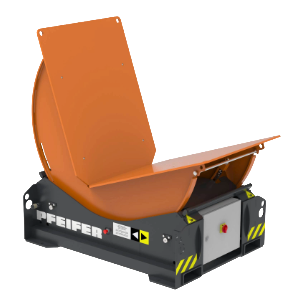
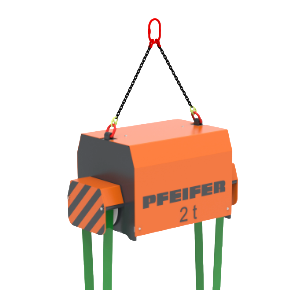
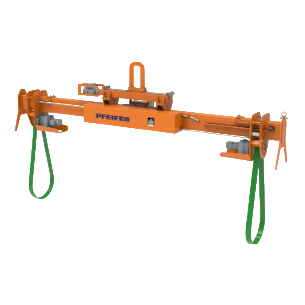
Good to know!
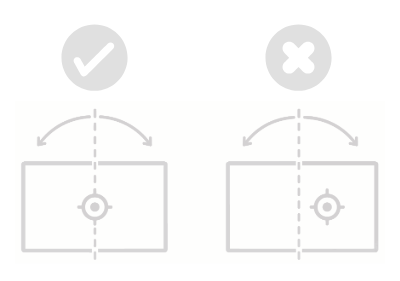
The centre of gravity and axis of rotation must be properly aligned
For a controlled turning process, the centre of gravity of the load should be located as close as possible to the axis of rotation. If the centre of gravity is significantly offset from the axis of rotation, high torques are generated. This can cause the load to accelerate uncontrollably, swing or transmit high forces to the turning device.
A well-designed system ensures that the load is safely guided throughout the entire turning process and that the drive is not subjected to unnecessary loads.

Load stability
Not every load is suitable for turning. Self-stable components with defined support surfaces are particularly well suited, such as machine components, welded frames or precast concrete elements. Turnover spreader beams and turning units therefore often use lifting belts that securely wrap around and guide the load.
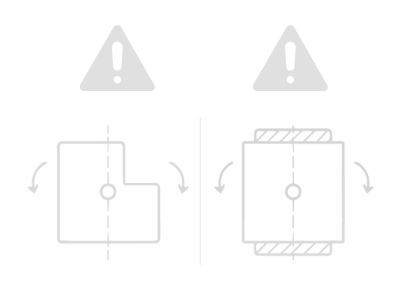
Consider the geometry of the load
The shape of the load is a key factor in determining whether turning is possible:
- Round or nearly square cross-sections can usually be turned easily.
- Irregular components require an individual assessment.
- Sharp-edged or sensitive surfaces require suitable protective measures.
- Long components must be secured against twisting and bending.

Not every narrow load can be turned easily
For narrow sheets and plates, the geometry is crucial. An unfavourable width-to-thickness ratio can cause the load to fail to roll over the edge in a controlled manner during turning, instead remaining in an almost vertical position.


Turning devices in use
Turning devices are used to turn heavy loads in a controlled and safe manner. They are used wherever components, coils, sheet metal packages or steel structures do not arrive in the correct position or need to be turned by 90° or 180° for the next processing step. This eliminates the need for risky manual repositioning or relocation using improvised aids.
They are used either as floor-mounted systems with turning tables or crane-mounted systems with turnover spreader beams and turning units. The aim is always a safe, defined and material-friendly turning process within production, storage or shipping. This speeds up processes, prevents damage and significantly improves occupational safety.